


This collection contains IAAO webinars published from 2010 to 2021. More recent webinars are available through IAAO-U on the main IAAO website.
Please note that CEU credits are no longer available for these videos.


























-
Dirt is Just Dirt, Isn't It? - Agricultural Land Valuation
Garth Thimgan
Agriculture has always played a major role in the development of civilization. This webinar will provide participants with a brief glimpse of the history of valuing agriculture land and also a glimpse at the importance of the role that agriculture plays in the economy of the United States. The webinar will then focus on the valuation of agricultural lands and the current approaches to its valuation. An emphasis will be placed on Use-Value, while other approaches will be shown, as well as some additional assessment tools that can be used in the valuation of agricultural lands.
-
Developing Effective Age Models
Errol Williams
Depreciation models are a function of age that reflects the condition of a property and highlights the decline in asset over time. Whenever properties are remodeled, the change in condition dictates recapturing the appreciation in the asset. This webinar introduces a new theory on effective age and outlines a clear procedure that captures asset appreciation. Using residential sales data in Harris County, Texas, effective age models are developed for different levels of remodeled residential properties. The results of the models are tested against sales and the appraised values of unsold remodeled residential properties, and yield all acceptable levels of estimates as outlined by the IAAO.
-

Supersize Me! The Valuation of Corporate Headquarters
Tim Wilmath
This presentation will cover the valuation of corporate headquarters and large single-occupant corporate campuses. Very large single-occupant office buildings and corporate headquarters exist in almost every jurisdiction. Often, these are some of the largest buildings in a jurisdiction. Because of their size and high assessments, they are often appealed, and assessors must wrestle with many interesting topics. This presentation will also review some of the more interesting and prominent corporate headquarters around the United States, including Facebook, Best Buy, Google, and Apple. These buildings contain some of the most interesting architecture and features and make great examples for how to address some of the common appraisal and assessment challenges.
-

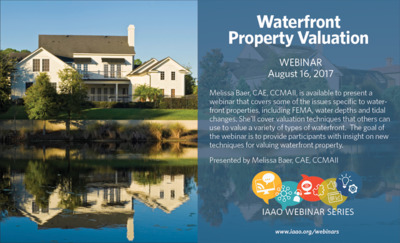
Waterfront Property Evaluation
Melissa Baer
Northeast Regional Manager, Melissa Baer, CAE, CCMAII, is available to present a webinar that covers some of the issues specific to waterfront properties, including FEMA, water depths and tidal changes. She'll cover valuation techniques that others can use to value a variety of types of waterfront. The goal of the Webinar is to provide participants with insight on new techniques for valuing waterfront property.
-
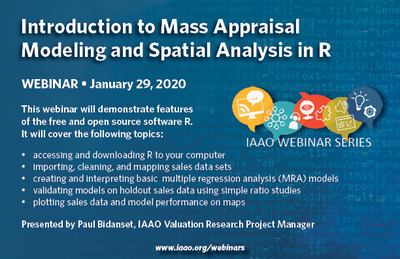
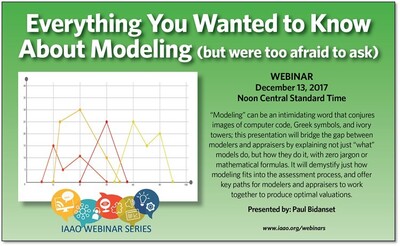
Everything You Ever Wanted to Know About Modeling
Paul Bidanset
Modeling can be an intimidating word that conjures images of computer code, Greek symbols, and ivory towers; this presentation will bridge the gap between modelers and appraisers by explaining not just what models do, but how they do it, with zero jargon or mathematical formulas. It will demystify just how modeling fits into the assessment process, and offer key paths for modelers and appraisers to work together to produce optimal valuations.
-

Becoming a Mobile Assessor
Billy Burle and Daniel Anderson
IAAO Webinar Series - This webinar will focus on the fact that field appraisers are mobile by nature, therefore your data should be mobile with them.
However, just going mobile or paperless is not enough. To truly realize the enormous productivity gains and cost savings possible you need to look for an integrated mobile solution.
This webinar will discuss the differences between mobile and integrated mobile including the importance of workflow, reporting, real-time field tracking, and quality control - all backed up by examples and real productivity stats courtesy of Travis Central Appraisal District.
-

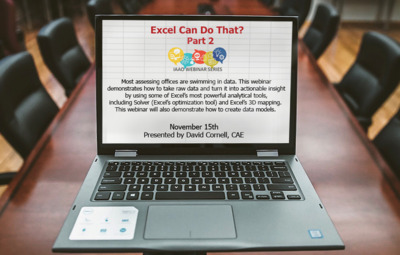
Excel Can Do That? Part 2.
David Cornell
Most assessing offices are swimming in data. This webinar demonstrates how to take raw data and turn it into actionable insight by using some of Excel's most powerful analytical tools, including Solver (Excel's optimization tool) and Excel's 3D mapping. This webinar will also demonstrate how to create data models.
Discover how Solver is used in the valuation process
Discover how to create conditional formatting
Discover how to create Tables - setup and advanced features
Discover how to create Pivot Tables and Pivot Charts (including how to add custom measures, including median values)
Discover how to connect Excel to different data sources
Discover how to create Data Models in Excel (very powerful!)
Discover how to use Power Query (one of the best new tools in Excel!) -
Excel Can Do That?
David M. Cornell
This presentation highlights many of Excel's underutilized features.
-

Research Like a Pro
Margie Cusack, Heather Steel, and Mary Odom
This webinar will focus on how the IAAO Research Library is so much more than books. Join us for an all new hands-on training for the do-it-yourself researcher. You'll learn to find benchmarking data, special property appraisal methods, easy shortcuts for researching assessment topics, practical tips for the novice researcher, and international resources for the not-so-faint-hearted. CEU's will not be offered with this webinar.
-

IAAO Designations: Review and Reveal
Tracy Drake, Brad Fowler, Paul Humble, Donna VanderVries, and Jarron Paronto
You might be closer than you think to earning an IAAO professional designation. Isn't it time to find out? With recent changes to key requirements, more professionals are now qualifying. Join members of the Professional Designations Subcommittee as they discuss these changes and take your questions on how they apply to you. You'll learn how to qualify for a designation without a college degree, how you can apply your AI or ASA designation towards an IAAO designation, and the latest on IAAO's newest designation, the Mass Appraisal Specialist.
-
Effective Conference Presentation Strategies
Peter Kienle
Peter Kienle reveals his best tips and tricks to become a top tier conference presenter. This exclusive 2-hour tutorial takes your presentation to the next level by sharpening your preparation and practice.
-
GIS/CAMA
Josh Ledgerwood and Michael Lomax
Learn to communicate the culture and values of your office and pick up a professional skillset that will advance your career and set you apart as a leader in your office.
-

Deliver Compelling & Captivating PowerPoint Presentations
Rob Moore and Kirk Boone
IAAO Webinar Series - This webinar will feature how PowerPoint is a powerful professional tool that can deliver high-quality presentations and is most effective when used as a visual complement to your instruction.
In this session, you will hear from Rob Moore, the lead instructional designer at the UNC School of Government, about techniques and skills that help you deliver compelling and captivating presentations with PowerPoint.
-

Update on Outdoor Advertising
Cris O'Neall, J. Walter Allen, and J. Allen Smith
The purpose of the webinar is to provide tax assessment officials and appraisers a thorough understanding of contemporary taxation and assessment principals for outdoor advertising signs and displays. Tax valuation and assessment experts will discuss the history of ad valorem tax treatment along with distinction of valuation for condemnation valuation purposes. The results of a national survey and perspective on outdoor advertising taxation and the uniformity doctrine will be included along with an analysis of specific tax cases from several states. This webinar is targeted for local and state tax assessment officials along with other appraisal/valuation experts so as to facilitate an understanding of outdoor advertising tax assessment matters particularly at the local level.
-

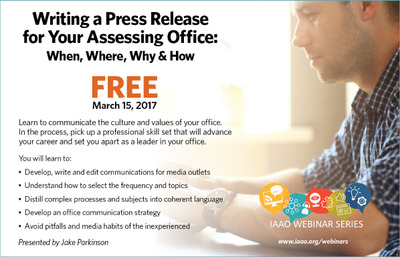
Writing a Press Release For Your Assessing Office
Jake Parkinson
Learn to communicate the culture and values of your office and pick up a professional skillset that will advance your career and set you apart as a leader in your office.
-

Experts on Evidence
Paul Sanderson
IAAO Webinar Series- Valuation disputes are a fact of life. Most assessors or appraisers will, at some time during their career, be required to explain their property valuation during litigation before a local or state board, or perhaps even a court of law.So, what can an assessor or appraiser do to ensure the best possible outcome if his or her valuation is subjected to such scrutiny? This presentation will provide assessors and appraisers with essential information that will help them to understand the hearing process and how they can competently support their valuation through both examination-in-chief and cross-examination.
-
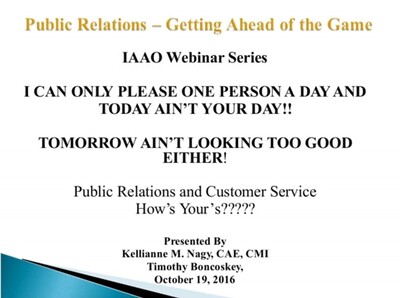
I Can Only Please One Person a Day and Today Ain't Your Day!
Tim Boncoskey and Kellianne Nagy
Webinar attendees will learn what customer service and public relations are and why they are needed in any office. We will focus on how effective customer service applies nine public relations objectives and 10 commandments of human relations. Presented by: Tim Boncoskey and Kellianne Nagy.
-
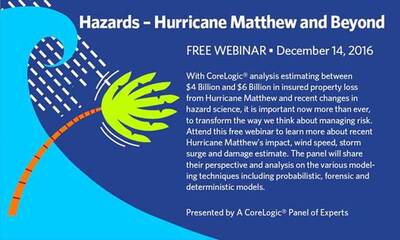
Hazards - Hurricane Matthew and Beyond
Curtis McDonald, Thomas Jeffery, Jim Siebers, David Smith, Aarti Desai, Laurel Di Silvestro, and Cory Payne
With CoreLogic analysis estimating between $4 Billion and $6 Billion in insured property loss from Hurricane Matthew and recent changes in hazard science, it is important to transform the way we think about managing risk. Attend this webinar to learn more about Hurricane Matthew’s impact, wind speed, storm surge and damage estimate. The panel will share their perspective and analysis on the various modeling techniques including probabilistic, forensic and deterministic models.
-

Big Data For Valuation Purposes
Michael Miller, Patrick O'Connor, and Mark Verrett
This two-hour workshop will give an overview of the history and future of Big Data and how it has impacted the appraisal industry. The instructors, Michael Miller, MAI; Patrick O'Connor, MAI; and Mark Verrett, SRA, will demonstrate the most current uses of Big Data and discuss specific ways to utilize Big Data to build client relationships, increase business, and simplify procedures.
-
Yavapai County Assessor vs. Zillow Showdown
Pam Pearsall
Yavapai County Assessor Pam Pearsall has kept an eye on the growing popularity of real estate website Zillow.com in recent years. With Zillow acquiring Trulia.com it is hard to deny the impact Zillow will have on the national real estate market. Assessor Pearsall wanted to gain perspective of Zillow's relative value estimate accuracy when compared with her annual 2016 tax year updated homes values and wanted to answer the question: "What is the potential for public use of Zillow estimates for and against us?" The results were revealing.
-

All Aboard! Taking a Train Ride Through Hotel Valuation
Toni Viens
The webinar will review the attributes of real, personal, and intangible property. Included in the webinar will be discussion of hotels' unique chart of accounts, hotel units of comparison, return on, and of, FF&E, utilization of Smith Travel Research (STR) reports including the HOST Report, and the Competitive Set Report.
-
Animating Your Vision: Successful Cultural Change
Bob Henriquez and Nereia Cormier
Changing the culture of an office can be one of the most challenging tasks an organization will ever face. This presentation will guide participants through a new administration's first year in office and demonstrate how it brought its vision to life through a comprehensive strategic planning process, employee morale initiatives, and technological innovations.
-

Taxation of Minerals and Mineral Interests
Calvin A. Kent
This webinar will discuss the legal issue of property taxation as applied to mineral interests, particularly those severed from surface interests, and how these affect the assessment process. A review of various approaches to the taxation of mineral interests in primary mineral-producing states will be considered. Investigation results will be shared on whether mineral taxes conform to the principles of a "good" tax. Suggestions will be provided on ways to improve assessment practices for mineral interests.
-
Regional Mall Valuations...Marketplace Solutions
Peter F. Korpacz
The valuation of regional malls is a continuing exercise that presents a number of unique issues. Mall classification methodology is very important within the mall part of the retail industry, but is not yet fully understood and embraced by appraisers. Fee simple and leased fee property interest controversies have needlessly complicated cap rate derivation and other valuation methodology and techniques. Lack of understanding of how malls operate and how investors view their positive and negative performance issues often results in methodology mistakes. This presentation will look to the marketplace to resolve these items and various other issues arising under all three traditional approaches to value.
-

International Trends in Property Tax
Paul Sanderson
In this webinar, Paul Sanderson will look at the key issues concerning property taxes around the world and comment on how different countries are addressing them. In particular, he will be looking at the "popularity" of property taxes, the burden of property taxes in different countries, the frequency of revaluations around the world, the different valuation bases used, current valuation issues, the volume of appeals and how they are dealt with in various jurisdictions.